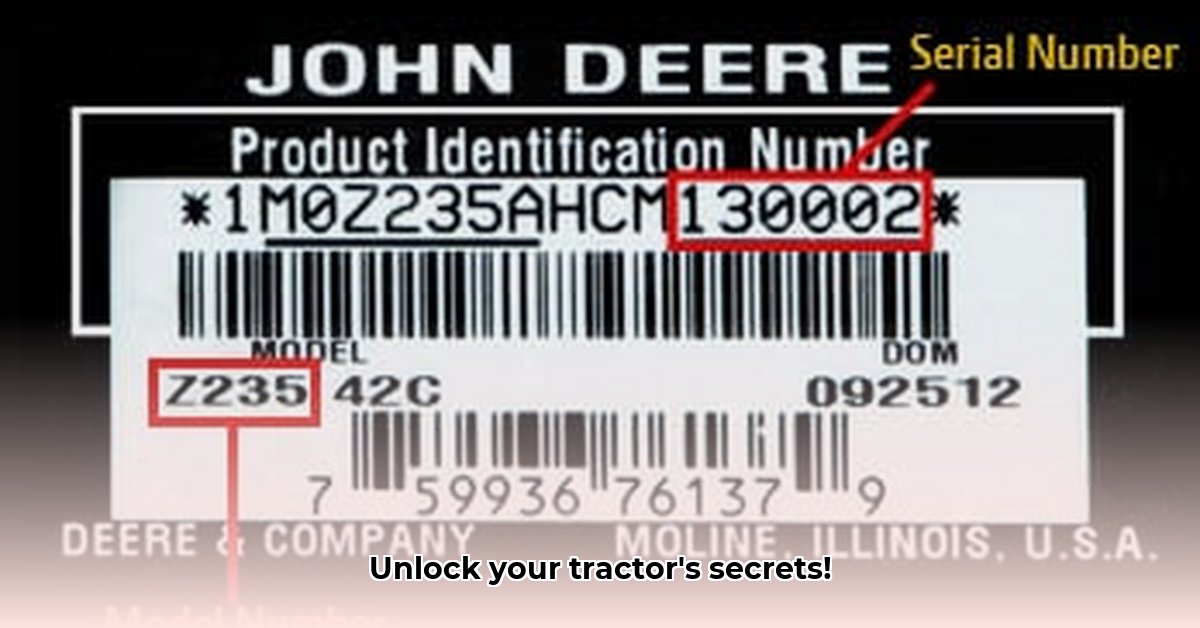
Understanding Your John Deere Tractor's Serial Number
Ever wondered about the seemingly random numbers and letters stamped on your John Deere tractor? They're not just an identification tag; they're a historical record, a key to unlocking your tractor's past, capabilities, and even its environmental impact. This guide provides a step-by-step process to decode this information, regardless of your tractor's age or your technical expertise. Knowing this information is crucial for maintenance, part sourcing, and understanding your tractor's place within the evolution of sustainable agriculture. For additional help, check out this helpful tractor serial number lookup.
Decoding Your Tractor's Identity: What the Serial Number Reveals
The information contained within your John Deere tractor's serial number varies depending on its manufacturing year. Older models typically have shorter, simpler serial numbers, while newer models feature longer alphanumeric codes reflecting the increasing complexity of modern agricultural machinery. This complexity allows for a far more detailed record of your tractor's specifications and history. Here's what you can potentially uncover:
- Manufacturing Year: Pinpoint the year your tractor was manufactured.
- Manufacturing Location: Identify the factory where your tractor was built (e.g., Iowa, Germany).
- Model Specifications: Determine the precise model and its unique features, aiding in part identification and understanding its capabilities.
- Engine and Transmission Details: Learn about the engine and transmission specifications, vital for maintenance and potential upgrades.
- Emission Standards Compliance: Determine which emission standards your tractor meets (e.g., Tier 3, Tier 4), crucial for environmental compliance and understanding its potential impact on sustainable farming practices. Has your tractor consistently met stricter environmental regulations over time?
A Step-by-Step Guide to Decoding Your Serial Number
Unfortunately, there's no single universal decoder for all John Deere serial numbers. The method depends on the serial number's format. However, this systematic approach will help you decipher the code:
Locate the Serial Number Plate: This typically is a metal plate attached to a prominent part of the tractor, possibly near the engine or operator's station. Take a clear photo for accurate data entry.
Examine the Serial Number Format: Observe the length and character types (numbers and letters). Older tractors have shorter numbers; newer ones possess longer alphanumeric codes.
Utilize Online Resources: Start with the official John Deere parts website, JDParts.com. Their database is the most reliable source for deciphering your tractor's serial number.
Engage Your Local John Deere Dealer: Your local dealer offers expert assistance. They possess access to detailed records and knowledgeable mechanics who can help you interpret the serial number and answer any questions you might have.
Connect with Online Communities: Join online forums dedicated to John Deere tractors. Connecting with other enthusiasts can provide valuable insights and support.
The Evolution of Serial Numbers: Reflecting Technological Advancements
The evolution of John Deere tractor serial numbers mirrors the remarkable progress in agricultural technology. Simple, shorter numbers on older models reflect a less complex era, whereas the longer, detailed codes on newer models highlight advancements in efficiency, sustainability, and precision farming. Each digit represents a piece of history, showcasing the industry's ongoing commitment to improving farming practices.
Beyond the Numbers: Deeper Insights and Practical Applications
Understanding your tractor's serial number isn't just about satisfying curiosity; it has practical implications:
Preventative Maintenance: Knowing your tractor's age and model allows for appropriate scheduling of maintenance, minimizing downtime and extending its lifespan. Did you know that regular maintenance can extend the life of your tractor by 25%?
Parts Sourcing: Accurate information ensures you obtain the correct parts, avoiding compatibility issues and costly mistakes. Can you quickly find the correct parts using the information from the serial number?
Regulatory Compliance: Emission standards information ensures compliance with environmental regulations. Knowing your tractor's emission standards is crucial in maintaining legal compliance.
Resale Value: A well-documented history, including serial number information, significantly enhances resale value.
Addressing Potential Challenges: Tips and Troubleshooting
While JDParts.com is the primary resource, remember that the format and information encoded in serial numbers can vary based on age and manufacturing location. Older tractors might have limited information. If you encounter difficulties, consult your John Deere dealer or online communities for further assistance. Have you found any unexpected information about your tractor through the serial number decoding?
Key Takeaways:
- Your John Deere tractor's serial number is a valuable resource providing insights into its age, origin, model specifics, and compliance with emission standards.
- Understanding this information is essential for efficient maintenance, cost-effective part replacement, and meeting environmental regulations.
- JDParts.com offers the most dependable and comprehensive information for decoding your tractor's serial number.
- Engaging with your local John Deere dealer and online communities can provide additional support and insights.